

Appearance
2.1 Tapered Membrane End Load
Problem Description
NAFEMS benchmark problem for a tapered membrane subjected to an end load, including geometry configuration, thickness, loading conditions, boundary constraints, material properties, and mesh details for finite element analysis validation.
Figure 1. Description of the validation problem 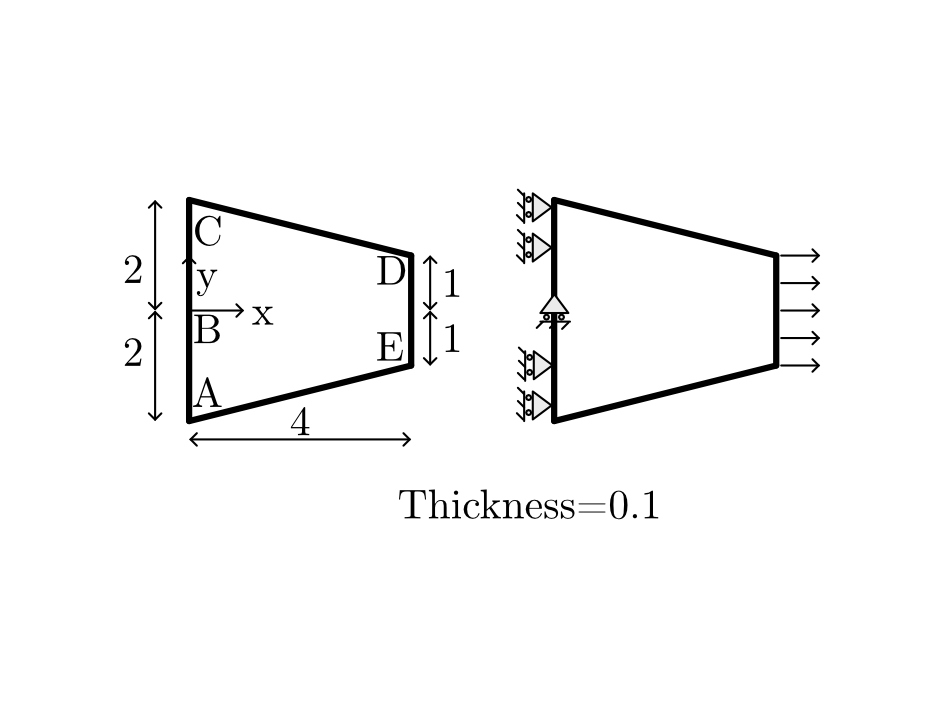
Extracted Details
| Field | Value |
|---|---|
| Origin | NAFEMS report LSB2 |
| Units | M, KN |
| Analysis Type | Linear elastic membrane |
| Geometry | Tapered membrane, length = 4, height varies (2 to 1), Thickness = 0.1 |
| Loading | Uniformly distributed horizontal load of 10 MN/m (pressure = 100 MPa) along outer edge DE |
| Boundary Conditions | Edge AC: zero displacement in x-direction; Point B: zero displacement in y-direction |
| Material Properties | Isotropic, E = 210 × 10³ MPa, ν = 0.3 |
| Element Types | Plane stress quadrilaterals or triangles |
| Meshes | 2 × 2 uniform mesh |
| Output | Direct stress σxx at point B |
| Target | 61.3 MPa (mesh refinement) |
Stress Distribution
Figure 2 shows the computed
Figure 2. Direct stress (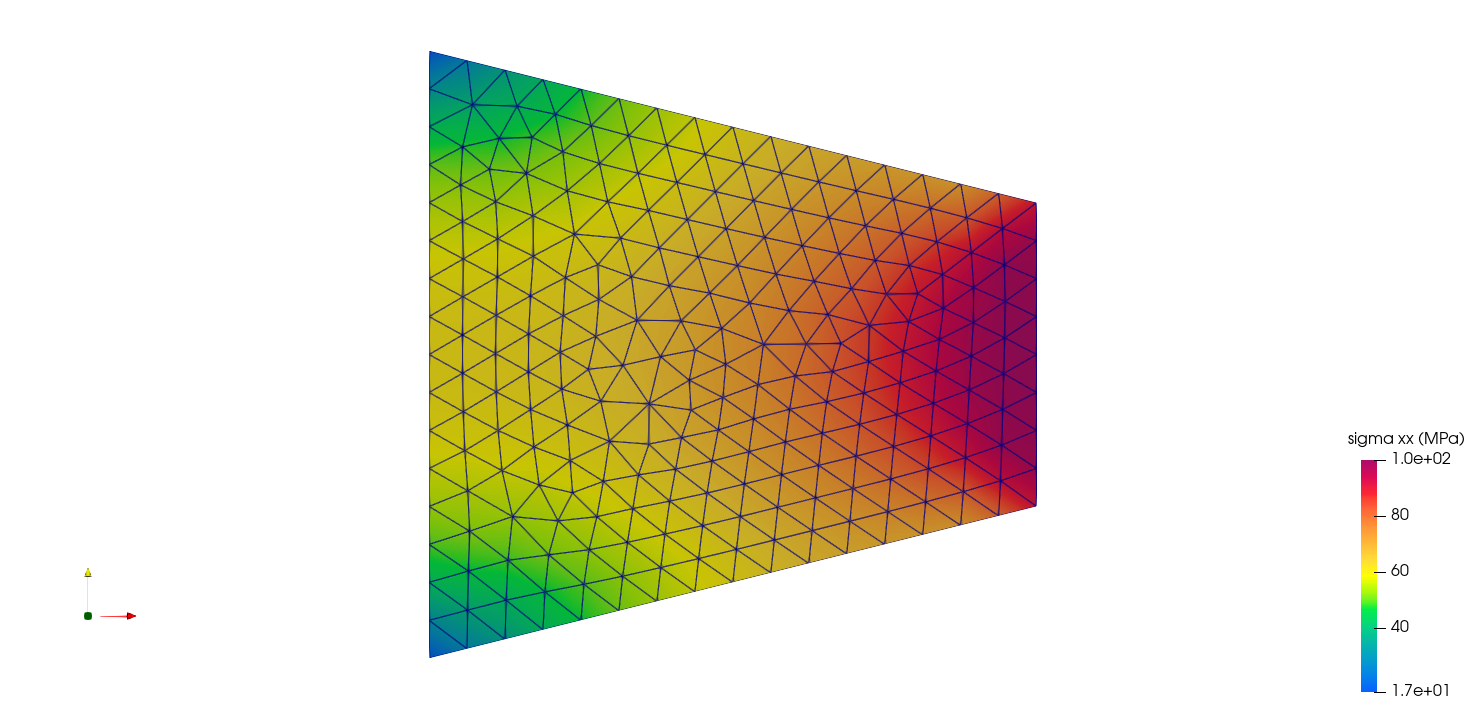
Mesh Convergence Study
The stress at Point B was evaluated for progressively refined meshes using both Continuous Galerkin (CG) Interpolation degree 1 and 2 finite elements.
Continuous Galerkin Degree 1 (CG1)
| Number of Nodes in mesh | Error (%) | |
|---|---|---|
| 24 | 59.18 | 3.46 |
| 104 | 60.66 | 1.04 |
| 142 | 61.05 | 0.41 |
| 718 | 61.24 | 0.10 |
| 2760 | 61.31 | 0.02 |
| 11250 | 61.33 | 0.05 |
Continuous Galerkin Degree 2 (CG2)
| Number of Nodes in mesh | Error (%) | |
|---|---|---|
| 24 | 59.21 | 3.41 |
| 104 | 60.89 | 0.67 |
| 142 | 61.09 | 0.34 |
| 718 | 61.27 | 0.05 |
| 2760 | 61.32 | 0.03 |
| 11250 | 61.33 | 0.05 |
| Figure 3 presents the convergence history for both element formulations. As the mesh is refined, the numerical solution approaches the NAFEMS reference value of 61.3 MPa. The CG2 formulation converges slightly faster than CG1; however, both formulations reach essentially the same converged solution for fine meshes. |
Figure 3. Mesh convergence of 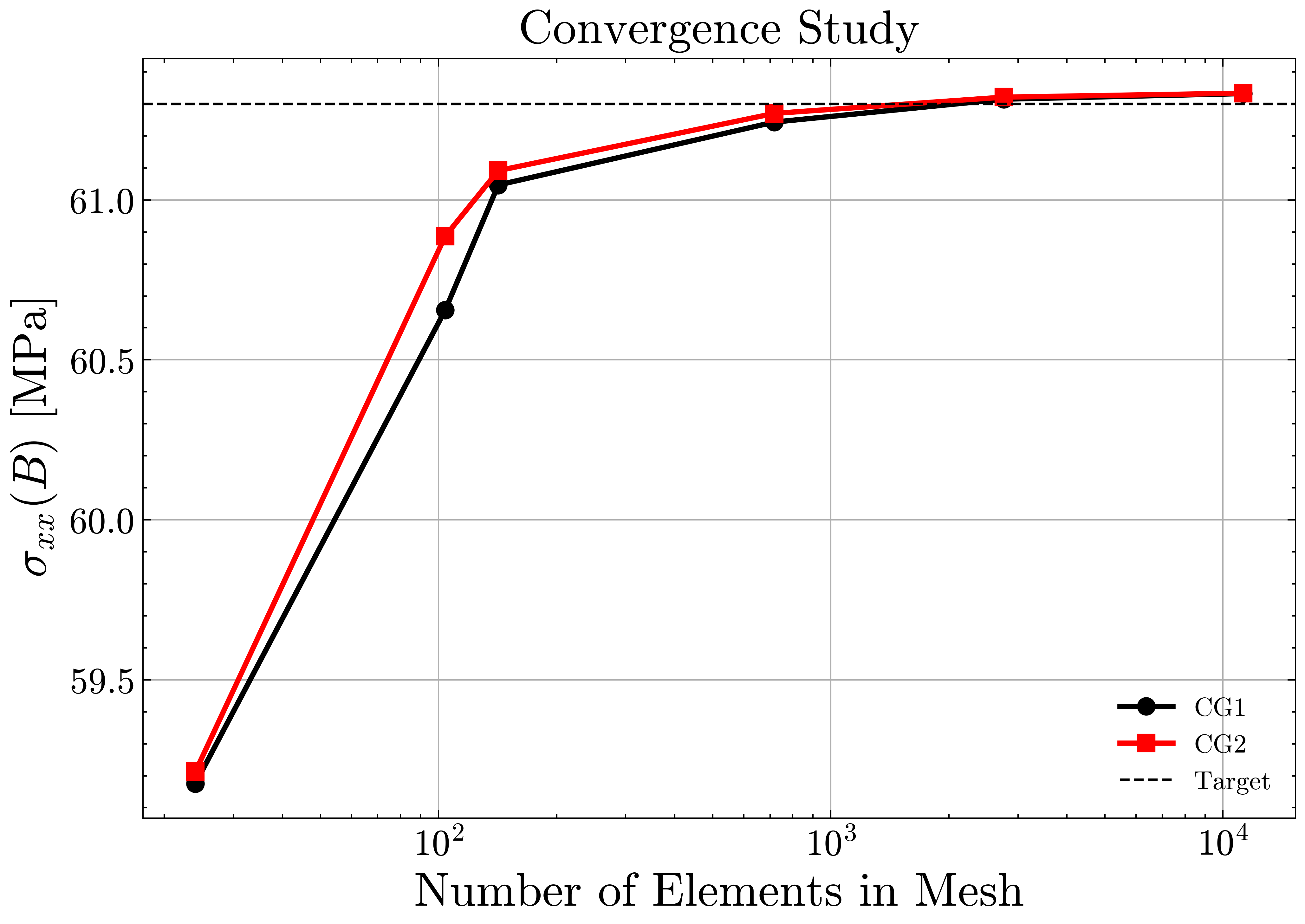
Converged Solution
For the finest mesh, the numerical solution produced:
| Quantity | Value |
|---|---|
| 61.33 MPa | |
| Benchmark Value | 61.30 MPa |
| Relative Error | 0.05 % |
The computed stress converges towards the benchmark value with mesh refinement. Continuous Galerkin Degree 2 (CG2) elements achieve the reference solution with fewer degrees of freedom, while both formulations converge to the same final value for sufficiently refined meshes.
Conclusion
The developed Linear Elastic Membrane Solver successfully reproduces the NAFEMS tapered membrane benchmark solution. The converged stress at Point B is 61.33 MPa compared to the benchmark value of 61.30 MPa, resulting in a relative error of only 0.05%. The excellent agreement verifies the correctness of the numerical implementation and provides confidence for subsequent structural and shell element analyses.